

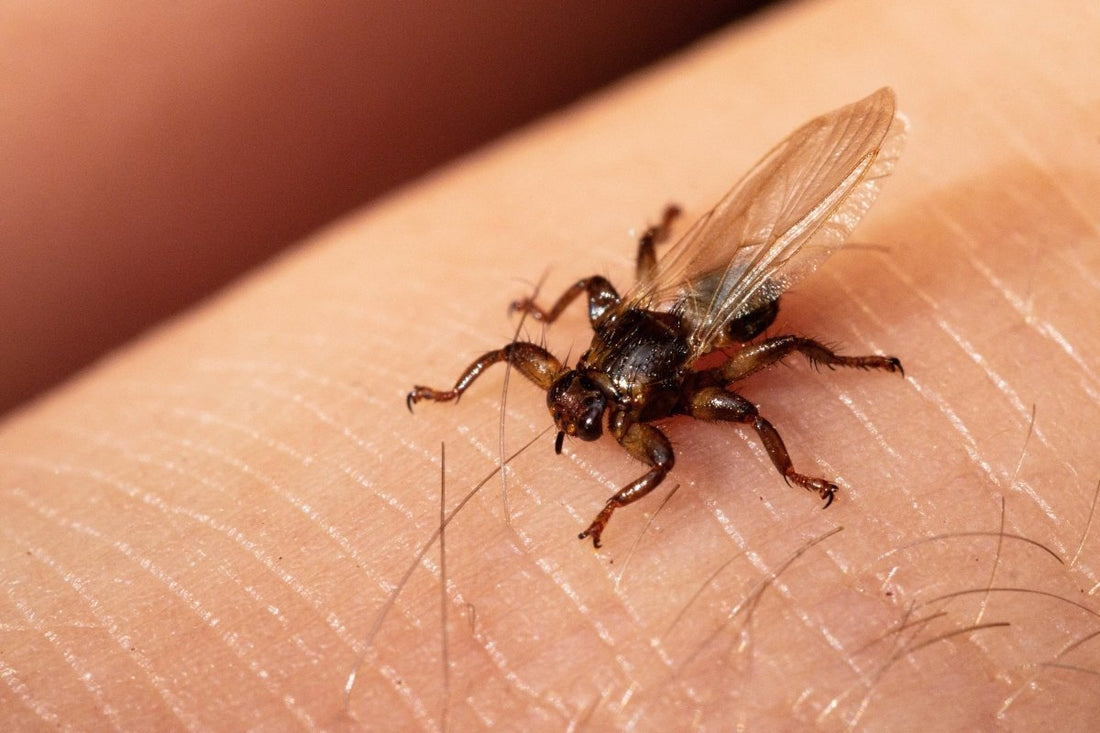
If you enjoy walking your dog through woods or meadows, you may have already encountered an uninvited companion: the deer ked . Often referred to as a "flying tick," it's a distinct insect—and quite a nuisance for both humans and dogs. Here you'll find everything you need to know as a dog owner: from identifying characteristics and potential risks to effective preventative measures.
What is a deer ked?
The deer ked (Lipoptena cervi) belongs to the group of so-called louse flies. Originally from Scandinavia, it is now widespread in Germany as well.
- Appearance: approximately 5–7 mm in size, brownish, with strong legs.
- Special feature: As soon as it finds a host animal (e.g. deer, roe deer, dog – or even humans), it sheds its wings and crawls through the fur or over the skin.
- Behavior: After landing, it moves very quickly, deliberately seeks a suitable spot to bite, and often bites multiple times . Unlike ticks, however, it does not attach itself.
Our video shows a deer ked crawling through the dog's fur.
Dangers for your dog
The deer ked is primarily a nuisance , but can also cause health problems:
- Painful bites: The sting can itch intensely and lead to skin irritation.
- Multiple bites: Because it doesn't attach itself firmly like a tick, it often bites several times – this can be particularly unpleasant.
- Secondary infections: Scratching can cause wounds that become infected.
- Transmission of pathogens: Research is still underway to determine whether deer keds can transmit dangerous diseases (e.g., bacteria such as Bartonella). What is certain is that a risk exists.
How do you recognize deer keds on a dog?
Unlike ticks, deer keds don't bite immediately . They often crawl through the fur for minutes before biting. Watch out for:
- Restlessness or sudden scratching and biting of the fur
- Visible small, brown insects that nimbly run through the fur.
- Small red spots or welts on the skin
When and where do deer keds lurk?
- Season: Late summer - autumn
- Habitat: Forest edges, game trails, dense undergrowth
- Risk: Particularly high in regions with large red and roe deer populations.
- In humans: The neck area is frequently targeted. A hood or other head covering can provide simple but effective protection.
How can you protect your dog?
Unfortunately, there is no absolute protection against deer keds. However, there are several measures that can significantly reduce the risk:
- Choose your walks carefully: During the season, avoid dense undergrowth or known game trails.
- Grooming: Thoroughly comb your dog after every walk in the woods – especially if it has long fur.
- Protective products: Many products that work against ticks and fleas (such as the TickAttack spray ) are also effective against the deer ked.
What to do if a deer ked bites you?
- Remove the insect immediately with your fingers or a flea comb.
- Gently disinfect the bite site.
- Observe whether the skin swells or becomes inflamed.
- In case of severe itching or unusual skin reactions: Consult a veterinarian!
Conclusion: Staying vigilant is worthwhile.
While deer keds aren't a reason to avoid the forest, they are creatures worth keeping an eye on. With a little attention, good grooming, and appropriate protective measures, you can make your dog's life considerably more comfortable.
👉 In short: Comb, check, protect – then you can enjoy carefree walks even during deer ked season!


